Central bank depository. Persistent inflation piques policymakers’ interest.
SEI’s view
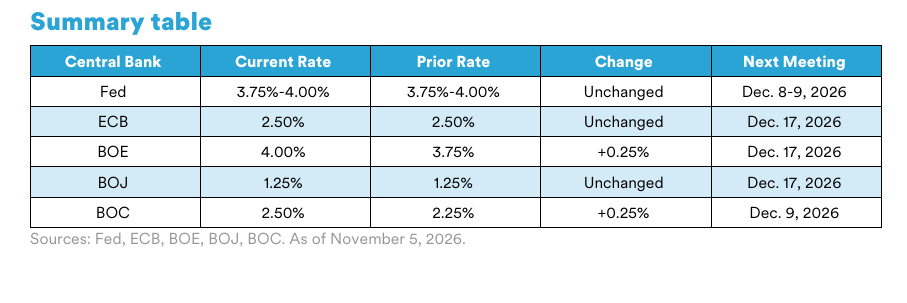
As expected, the Federal Reserve (Fed) held the federal funds rate steady at its meeting in late October while highlighting the strength of the U.S. economy and persistent above-target inflation. Fed Chair Kevin Warsh also noted that financial conditions have tightened but stopped short of characterizing them as tight. More notable was a procedural change introducing a dedicated monetary policy strategy meeting without a vote on the federal funds rate or an accompanying policy statement. The move marks another incremental shift by Warsh away from the framework that took shape under former Fed Chair Ben Bernanke in the aftermath of the global financial crisis of the late 2000s. The European Central Bank (ECB) also held rates steady following its previous hike, although President Christine Lagarde’s announcement that she will step down in February 2027, dominated attention. Speculation around her successor is already building, with Klaas Knot, a former member of the ECB Governing Council, and Pablo Hernández de Cos, a former governor of the Bank of Spain, viewed as leading candidates. Elsewhere, the Bank of England (BOE) and the Bank of Canada (BOC) both raised their benchmark interest rates for the first time since 2023, as inflation pressures intensified. The BOE also raised its inflation forecast, with the consumer-price index (CPI) now expected to approach 5% in 2027. Despite the recent rally in U.S. Treasury yields, SEI continues to expect that yields will move higher, with technical positioning likely to amplify volatility and produce larger market moves as yields trend upward. Outside the U.S., risks appear more two-sided, as the ECB, BOE, and BOC navigate soft-to-moderate economic growth alongside above-target inflation, potentially leaving less room for monetary policy adjustment.
Federal Reserve (Fed)
- In a split 10-2 vote at its October 27-28 meeting, the Federal Open Market Committee (FOMC) maintained the federal funds rate in a range of 3.75% to 4.00% but signaled that future rate hikes are not off the table. Two Committee members favored a 25-basis-point (0.25%) increase.
- In its statement announcing the policy decision, the FOMC expressed its view that the U.S. economy is “expanding at a strong pace,” an upgrade from its characterization of the economy as “solid” in its September statement. The FOMC also noted, “Inflation remains elevated. The accumulation of more information will help the Committee determine the policy stance appropriate to ensure a timely return of inflation to the Committee’s two percent goal.”
During a news conference following the FOMC meeting, Fed Chair Kevin Warsh said keeping interest rates steady was “the right decision for this moment.” Warsh reiterated the central bank’s commitment to fight inflation. “There’s no soft inflation target,” he commented. “Quashing inflation is not about some fixed individual date on a calendar, the same way it's not about some isolated data point. I’m encouraged by the progress we’ve made in a short period of time.”
European Central Bank (ECB)
- The ECB voted unanimously to keep its benchmark interest rate unchanged at 2.50% during its October 28-29 meeting but left open the possibility of future rate hikes due to sticky inflation.
- In a news release, the ECB’s Governing Council commented, “The increased magnitude and duration of the energy shock, as well as the implications for indirect and second-round effects, are likely to drive up inflation and lower growth…The Governing Council is committed to setting monetary policy to ensure that inflation stabilises at its 2% target in the medium term.” The Governing Council also noted that it is not pre-committing to a particular rate path.
- Shortly before the release of its policy decision, the central bank announced that ECB President Christine Lagarde will step down from her position, effective February 7, 2027―eight months before the end of her term. In a video posted online, Lagarde, who has served as ECB president since 2019, said, “It has been a great pride and a huge privilege to serve this institution. I leave this institution with a sense of good work done.”
Bank of England (BOE)
- At its meeting on November 5, the BOE voted by a margin of 8-1 to raise the Bank Rate by 0.25% to 4.00%―the first rate hike since August 2023―citing the continued impact of the Middle East war on energy prices. Monetary Policy Committee (MPC) member Catherine L. Mann favored a 0.50% rate increase.
- The MPC stated, “The conflict in the Middle East is now in its ninth month. Global energy prices have continued to rise from an already elevated level. UK CPI inflation increased to 3.5% in September. It is now expected to rise to around 5% by the middle of next year. It is then projected to fall as the impact of rising energy prices on 12-month inflation rates fades, and still restrictive monetary policy bears down on inflation.”
- The central bank’s announcement provided insights into the views of the MPC members. BOE Governor Andrew Bailey discussed the possibility of future rate hikes. “Without news which softens the risks to inflationary pressures, I can see the argument for a further increase in rates and thereafter taking a more conditional approach, dependent on the evidence on energy prices and inflation dynamics.”
Bank of Japan (BOJ)
- At its meeting on October 29-30, the BOJ’s Policy Board voted by an 8-1 majority to maintain its benchmark interest rate at a 31-year high of 1.25%. Board member Takata Hajime voted for a 0.25% rate increase to 1.50%.
- In a statement announcing the rate decision, the central bank commented that inflation has reached its 2% target rate. “With a sense of labor shortage continuing to be strong, the mechanism in which wages and prices rise moderately in interaction with each other has been operating, and medium- to long-term inflation expectations are at around 2 percent.”
- During a news conference following the meeting, BOJ Governor Kazuo Ueda said, ”Underlying inflation has reached levels consistent with our price target. Financial conditions remain accommodative. There are various upside risks. We must therefore be vigilant to the risk of inflation overshooting our target.”
Bank of Canada (BC)
- The BOC raised its policy rate by 0.25% to 2.50% at its October 28 meeting and indicated that additional rate hikes may be needed to combat sticky inflation.
- In a statement announcing the monetary policy decision, the central bank noted that the ongoing Middle East war continues to push energy prices higher. “The conflict in the Middle East is now in its eighth month and there is no clear path to resolution. The combination of higher-for-longer energy prices and increased pass-through adds to the persistence of inflation in the projection,” the BOC commented. “CPI inflation is expected to average 3% in 2027, a percentage point above the July projection, then come down to 2% in the middle of 2028. The main sources of uncertainty around this forecast are developments in the Middle East and businesses’ responses to cost pressures.”
At a news conference following the interest-rate announcement, BOC Governor Tiff Macklem said, “With the outlook for inflation substantially higher and the economy showing resilience, an increase in the policy rate is needed to reduce the risk that elevated energy prices could spill over and become generalized inflation. There could be a need to increase the policy rate further, but given uncertainties, we will proceed carefully.”
GLOSSARY AND INDEX DEFINITIONS
For financial term and index definitions, please see: https://www.seic.com/ent/imu-communications-financial-glossary
IMPORTANT INFORMATION
This material represents an assessment of the market environment at a specific point in time and is not intended to be a forecast of future events or a guarantee of future results. All information as of the date indicated. There are risks involved with investing, including possible loss of principal. This information should not be relied upon by the reader as research or investment advice, (unless you have otherwise separately entered into a written agreement with SEI for the provision of investment advice) nor should it be construed as a recommendation to purchase or sell a security. The reader should consult with their financial professional for more information.
Statements that are not factual in nature, including opinions, projections, and estimates, assume certain economic conditions and industry developments and constitute only current opinions that are subject to change without notice. Nothing herein is intended to be a forecast of future events, or a guarantee of future results.
Certain economic and market information contained herein has been obtained from published sources prepared by other parties, which in certain cases have not been updated through the date hereof. While such sources are believed to be reliable, neither SEI nor its affiliates assumes any responsibility for the accuracy or completeness of such information and such information has not been independently verified by SEI.
There are risks involved with investing, including loss of principal. The value of an investment and any income from it can go down as well as up. Investors may get back less than the original amount invested. Returns may increase or decrease as a result of currency fluctuations. Past performance is not a reliable indicator of future results. Investment may not be suitable for everyone.
This material is not directed to any persons where (by reason of that person's nationality, residence or otherwise) the publication or availability of this material is prohibited. Persons in respect of whom such prohibitions apply must not rely on this information in any respect whatsoever.
The information contained herein is for general and educational information purposes only and is not intended to constitute legal, tax, accounting, securities, research or investment advice regarding the strategies or any security in particular, nor an opinion regarding the appropriateness of any investment. This information should not be construed as a recommendation to purchase or sell a security, derivative or futures contract. You should not act or rely on the information contained herein without obtaining specific legal, tax, accounting, and investment advice from an investment professional.
Information in the U.S. is provided by SEI Investments Management Corporation (SIMC), a wholly owned subsidiary of SEI Investments Company (SEI).
Information in Canada is provided by SEI Investments Canada Company, a wholly owned subsidiary of SEI Investments Company (SEI), and the Manager of the SEI Funds in Canada.
In the UK and the EEA this information issued in the UK by SEI Investments (Europe) Ltd, 1st Floor, Alphabeta, 14-18 Finsbury Square, London EC2A 1BR which is authorised and regulated by the Financial Conduct Authority.
The contents of this document have not been reviewed by any regulatory authority in Hong Kong. You are advised to exercise caution in relation to the offer. If you are in any doubt about any of the contents of this document, you should obtain independent professional advice.
This document has not been registered as a prospectus with the Monetary Authority of Singapore.
This information is made available in Latin America and the Middle East FOR PROFESSIONAL (non-retail) USE ONLY by SIEL.
This material is provided for general information and educational purposes only and does not constitute financial advice as contemplated in the Financial Advisory and Intermediary Services Act, 2002, nor a recommendation, offer or solicitation to buy or sell any financial product. It has not been prepared with regard to the investment objectives, financial situation or particular needs of any individual investor. Past performance is not a guarantee of future results. Investing involves risk, including the possible loss of principal. Issued in South Africa by SEI Investments (Europe) Ltd, an authorised financial services provider (FSP No. 9796). Certain underlying investment commentary may be prepared by SEI Investments Management Corporation or other SEI affiliates. Investors should obtain appropriate professional advice before making an investment decision.
This information is provided for general informational purposes only and is intended solely for institutional investors and other persons who may lawfully receive it under applicable Singapore laws and regulations. It is not directed at retail investors. Nothing contained herein constitutes an offer, solicitation, recommendation or invitation to subscribe for, purchase, sell or hold any investment, financial product or service. The availability of any investment strategy, fund or service in Singapore is subject to applicable Singapore laws and regulations.
Any questions you may have in relation to its contents should solely be directed to your Distributor. If you do not know who your Distributor is, then you cannot rely on any part of this document in any respect whatsoever.