U.S. midterms: Riding the wave.
While the Democratic Party was expected to regain the U.S. House of Representatives, it outperformed expectations in both the House and the Senate, as well as several state-level races, resulting in a “blue wave.” The outcome sets up an interesting dynamic for the last two years of Donald Trump’s current presidency, and investors will have to determine how to best navigate the resulting effects.
The initial legislative plans of the next Congress have not been articulated formally, but we can piece together a fairly obvious list of priorities, including reversing cuts to Affordable Care Act (ACA) subsidies and Medicaid, the Iran war, trade policy and inflation, as well as House - led investigations of administration officials and perhaps some private -sector connections. While there will be both upside and downside risks, there are still plenty of uncertainties, of both the known and unknown varieties.
A favorable outcome would consist of a prudent approach to regulation and constructive engagement on the federal budget, military conflict, and trade. Less favorable would be heavy-handed regulation ,aggressive fiscal measures , and bitter division with the White House that result in continued upward pressure on interest rates and costs of living .
A tsunami of discontent
Democrats’ performance at the federal and state levels was notably better than anticipated. As with real estate, most elections are local or regional (especially in the case of midterms), so voter motivations were diverse. But plausible ones include dissatisfaction with certain policies of the Trump Administration, frustrations with stubbornly elevated energy, food, and healthcare costs, and overall political momentum shifting away from Republicans and toward Democrats.
Policy ambitions will run into Senate and veto realities
Exhibit 1 lists the likely priorities of the next Congress based on public remarks, primarily those of presumptive House Speaker Hakeem Jeffries.
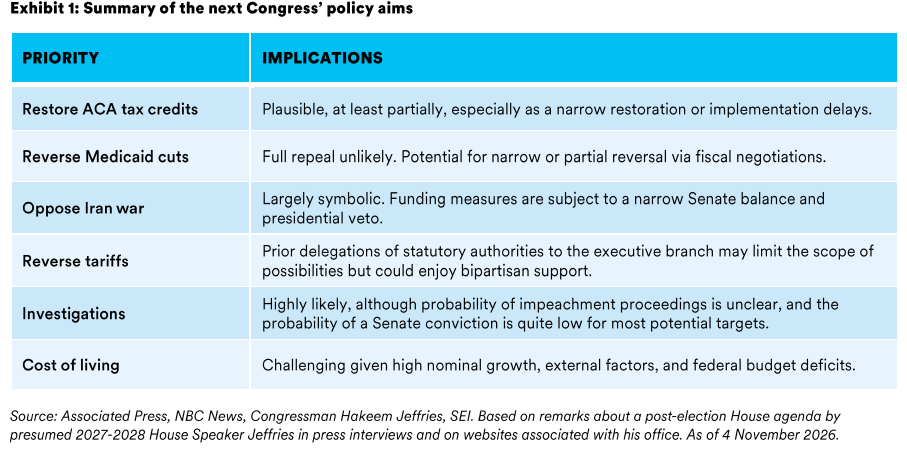
Reducing cost -of-living pressures has received significant attention. However, given the important role played by factors that are largely outside the control of legislators — wars in Eastern Europe and the Middle East, the massive artificial intelligence (AI) capita l expenditure (capex) cycle, persistently large government deficits around the world, supply chain resilience objectives, growing military expenditures, rising old -age dependency in many countries, etc. — Democrats need to carefully manage expectations on this front. Inflation pressures have helped take down a number of incumbent governments around the world, whether left - or right -leaning, in recent years.
The House typically initiates investigations as part of the U.S. government’s system of checks and balances, and it seems quite likely that there will be investigations of various individuals within, and connected to, the Trump Administration. Despite Demo crats’ larger -than-expected margin in the Senate, the balance of power seems likely to prevent conviction of any impeached individuals, including the president. It’s also worth noting that a number of individuals within the administration may resign in coming months as the current Trump presidency winds down in 2027 and 2028. Desires to investigate and prosecute could vary quite a bit among individual Democratic representatives and senators. How much time and effort is ultimately dedicated to this remains to be seen.
It is likely that trade policy, an area where Congress has ceded significant authority to the executive branch over many decades, will receive attention. It’s not yet clear where it will initially fall on the list of Congressional priorities. However , if President Trump were to enact additional tariffs on trade partners (in retaliation towards investigations, for example), trad e could move up the list. It’s also worth noting that reasserting the role of Congress in trade policy and rolling back some o f the president’s protectionist measures have a degree of bipartisan support, so some action on this front is plausible.
Efforts to constrain the Iran -U.S. conflict are likely. As with trade, this is an area where Congress has gradually ceded powers to the executive branch over time, but it retains important authorities through the War Powers Resolution and control over appropritions. However, the practical effectiveness of those authorities could be limited by narrow margins in the Senate and the presidential veto.
Reversing recent reductions to projected Medicaid spending, driven largely by work and eligibility requirements, more frequent eligibility reviews, and restrictions on state Medicaid financing, may be an early target of congressional legislation, but would remain subject to President Trump’s veto.
Finally, it’s important to pay attention to fault lines between Democrats in the incoming Congress. While the impressive gains in both chambers of Congress may reduce the influence of far -left members, these priorities will nonetheless be subject to internal negotiation s that could be intense at times.
U.S. government budget realities are the next wave on the horizon
Exhibit 2 indicates that the U.S. Treasury is going to run into its current debt-ceiling limit sometime during the next Congress. According to the Bipartisan Policy Center, the ceiling is likely to be reached by mid -2027, with extraordinary measures likely to provide another two or three quarters of payments, including debt service. In other words, Congress and the Trump administration will need to hammer out some sort of fiscal agreement by late 2027 or early 2028.
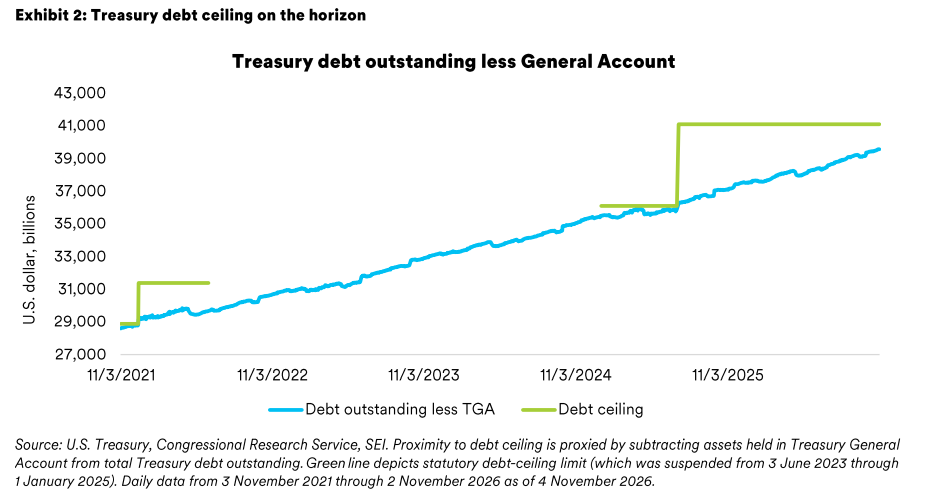
In addition, the current continuing resolution funds the government only through mid -December of this year. Therefore, the current Congress also has a role to play in the U.S. budget outlook. And it’s possible that a short -term stopgap measure will place a new budget resolution front and center for the next Congress.
The bottom line is that, while legislative and investigative agendas of the next Congress may have limited impact on the glob al economy and financial markets, there’s a very real risk of fiscal negotiations causing market volatility in the months and quarters ahead. Indeed, after an initially positive market reaction on the day after the elections, remarks on wealth and similar taxes may be contributing to a sudden return of elevated market volatility. If there’s a potential silver lining to this reality, it’s that it may spur the incoming Congress and the Trump administration to engage in constructive negotiations on some fronts. Unfortunately, rancor between Democrats and the White House appears to be intensifying already, and we’re still two months out from the new Congress being sworn in. At this point, it’s fair to say there are still plenty of unknowns.
The upshot for investors
Financial market behavior doesn’t neatly follow economic or political cycles, and political dynamics can be very difficult to predict. A clearer picture of the legislative and investigative priorities of the next Congress should materialize in coming month s, and we’ll then have a better idea of how markets and economies might be impacted. In the meantime, fiscal risks are front and center and should be closely watched. At this point, we continue to believe that the global economy is in a higher - for-longer era, whether that be capex, military expenditures, government budget deficits, inflation or interest rates. We think that investors should continue to take advantage of diversification and, where appropriate, active allocation tilts and active management.
GLOSSARY AND INDEX DEFINITIONS
For financial term and index definitions, please see: https://www.seic.com/ent/imu-communications-financial-glossary
IMPORTANT INFORMATION
This material represents an assessment of the market environment at a specific point in time and is not intended to be a forecast of future events or a guarantee of future results. All information as of the date indicated. There are risks involved with investing, including possible loss of principal. This information should not be relied upon by the reader as research or investment advice, (unless you have otherwise separately entered into a written agreement with SEI for the provision of investment advice) nor should it be construed as a recommendation to purchase or sell a security. The reader should consult with their financial professional for more information. Diversification may not protect against market risk. Bonds and bond funds will decrease in value as interest rates rise. High yield bonds involve greater risks of default or downgrade and are more volatile than investment grade securities, due to the speculative nature of their investments.
Statements that are not factual in nature, including opinions, projections and estimates, assume certain economic conditions and industry developments and constitute only current opinions that are subject to change without notice. Nothing herein is intended to be a forecast of future events, or a guarantee of future results.
Index returns are for illustrative purposes only, and do not represent actual performance of an SEI Fund. Index returns do not reflect any management fees, transaction costs or expenses. Indexes are unmanaged and one cannot invest directly in an index. Pas t performance does not guarantee future results.
Certain economic and market information contained herein has been obtained from published sources prepared by other parties, which in certain cases have not been updated through the date hereof. While such sources are believed to be reliable, neither SEI n or its affiliates assumes any responsibility for the accuracy or completeness of such information and such information has not been independently verified by SEI.
The information contained herein is for general and educational information purposes only and is not intended to constitute legal, tax, accounting, securities, research or investment advice regarding the strategies or any security in particular, nor an opinion regarding the appropriateness of any investment. You should not act or rely on the information contained herein without obtaining specific legal, tax, accounting and investment advice from an investment professional.
The views contained herein are not to be taken as advice or a recommendation to buy or sell any investment in any jurisdiction. Our outlook contains forward -looking statements that are judgments based upon our current assumptions, beliefs, and expectations . If any of the factors underlying our current assumptions, beliefs or expectations change, our statements as to potential future events or outcomes may be incorrect. We undertake no obligation to update our forward-looking statements.
Information in the U.S. is provided by SEI Investments Management Corporation (SIMC), a wholly owned subsidiary of SEI Investments Company (SEI).
Information in Canada is provided by SEI Investments Canada Company, a wholly owned subsidiary of SEI Investments Company (SEI), and the Manager of the SEI Funds in Canada.
Information issued in the UK by SEI Investments (Europe) Limited, 1st Floor, Alpha beta, 14 -18 Finsbury Square, London EC2A 1BR which is authorised and regulated by the Financial Conduct Authority. Investments in SEI Funds are generally medium - to long -term investments.
This information is made available in Latin America, the Middle East, the Nordics, and Australia FOR PROFESSIONAL (non -retail) USE ONLY by SIEL.
Any questions you may have in relation to its contents should solely be directed to your Distributor. If you do not know who your Distributor is, then you cannot rely on any part of this document in any respect whatsoever.
Issued in South Africa by SEI Investments (Europe) Ltd, an authorised financial services provider (FSP No. 9796). This material is provided for general information and educational purposes only and does not constitute financial advice as contemplated in th e Financial Advisory and Intermediary Services Act, 2002. It has not been prepared with regard to the investment objectives, financial situation or particular needs of any individual investor. Any reference to portfolio positioning represents SEI's investment views at the date of publication and may differ between portfolios and mandates. Investors should obtain appropriate professional advice before making an investment decision.
This information is provided for general informational purposes only and is intended solely for institutional investors and other persons who may lawfully receive it under applicable Singapore laws and regulations. It is not directed at retail investors. Nothing contained herein constitutes an offer, solicitation, recommendation or invitation to subscribe for, purchase, sell or hold any investment, financial product or service. The availability of any investment strategy, fund or service in Singapore is subject to applicable Singapore laws and regulations.