Mission alignment: Crafting a North Star investment policy.
Every foundation and nonprofit organization exists to advance a mission, whether to protect the environment, improve public health, expand educational opportunity, reduce poverty, or address countless other challenges. The work of these organizations typically flows through grantmaking, programs, or advocacy. Yet one of the most powerful tools available to any mission-driven organization often goes largely unexamined: the investment portfolio.
Just as the North Star has led travelers to their destination for thousands of years, the investment policy statement (IPS) sets the direction for the investment portfolio. By incorporating mission into the IPS, organizations can chart a course toward clearer alignment between their programmatic work and their assets. A well-crafted IPS aligned with mission and values can be a constant across changing market cycles, leadership transitions, and committee turnover.
Mission matters
For most foundations and endowed nonprofits, financial assets represent the vast majority of the organization’s resources. Annual distributions for charitable purposes, typically around 5% for private foundations, are only one part of the picture. The remaining assets are invested in the capital markets every day, raising an important question: Are those investments aligned with your mission or working against it?
The IPS is the governing document that guides how an organization’s endowment or investment portfolio is managed. It establishes objectives, risk parameters, asset allocation, roles and responsibilities. Increasingly, forward-thinking boards and investment committees are asking how the IPS can better reflect who they are and what they stand for.
Mission-aligned investing (MAI), also referred to as mission-related investing (MRI), is the practice of incorporating an organization’s mission and values into the management of its investment portfolio. This is not simply an ethical statement; it is a strategic position. Organizations that align their investments with their mission may reduce reputational risk, strengthen donor relationships, create more durable institutional direction, and amplify the impact of their work.
This primer is designed for investment committee members, board members, and nonprofit executives who are considering whether and how to incorporate mission into their IPS. It provides a practical overview of the available investment approaches, guidance on working effectively with your outsourced chief investment officer (OCIO), and a discussion of the meaningful benefits a thoughtfully constructed mission-aligned IPS can deliver to your organization.
Incorporating mission into your IPS
Incorporating mission into an IPS is less a single decision than an ongoing conversation involving your board, investment committee, executive leadership, and investment advisers. The process begins with self-examination: understanding what your organization values most, where your boundaries lie, and how ambitiously you want to deploy assets. From there, it is a matter of translating those values into concrete language and investment guidelines within your IPS.
The IPS is a governing document owned by the organization—not by your investment manager or OCIO—and it should be written with clarity and specificity to inform investment decisions while remaining flexible enough to implement across market cycles and leadership transitions. Mission alignment should be treated with the same seriousness as your return objectives, liquidity requirements, or risk tolerance. Done thoughtfully, it can be the North Star that informs foundational decision-making and sets the direction for your investments.
Five questions for your investment committee
As your organization works toward incorporating your mission into your IPS, it will be important for the investment committee to create a collective understanding of objectives and approaches. The following questions provide a starting point for committee discussions:
- What is the relationship between our mission and our investment portfolio? This foundational question invites the committee to examine whether the organization’s endowment is currently invested in ways consistent with, or potentially at odds with, its stated mission. This discussion should surface any existing conflicts and establish a shared understanding of what alignment means for your organization.
- Which issues are most important to us, and where do we draw the line? Mission alignment exists on a spectrum. Some organizations may wish to avoid only the most egregious conflicts while others may want their entire portfolio to advance their cause actively. This question is an opportunity to distinguish between fixed rules and areas where greater flexibility is more appropriate.
- Are we willing to accept a different risk/return profile in exchange for clearer mission alignment? This is one of the most important practical questions a committee can address. The evidence on whether mission-aligned portfolios under- or overperform traditional portfolios is nuanced and evolving. In reality, the answer is, “It depends.” Mission-aligned investments may carry more tracking error, lower liquidity, higher fees, or other characteristics that present trade-offs with the existing portfolio. The committee should reach agreement on its financial expectations before committing to specific approaches.
- How do we want to structure and document our approach so it endures over time? Investment committees turn over. Executive directors change. The institutional knowledge and clarity that informed the mission-alignment strategy can erode over time if not embedded in your governing documents. This question focuses the committee on the importance of codifying your approach in the IPS itself, so that your mission-aligned direction is durable, legible to new members, and part of the institutional memory of the organization.
- How will we measure success? This question moves the committee from aspiration to accountability by defining what successful mission alignment should look like in practice. The discussion should uncover which outcomes matter most, such as reduced exposure to mission conflicts, increased allocation to mission-supportive investments, improved stakeholder confidence, or clearer reporting, and how the organization will monitor progress over time. This is also the place to set goals and time horizons, if applicable.
Working with your OCIO
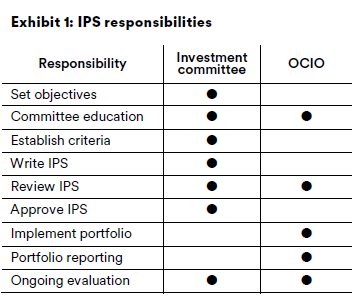
For many foundations and nonprofits, we believe the OCIO relationship serves as the primary investment adviser, sharing fiduciary responsibility for implementing and managing the investment portfolio within the established confines of the organization’s board and investment committee. The OCIO relationship is critical to the success of any MAI initiative, but it is equally important to understand the distinct roles each party plays.
Your OCIO can be a valuable strategic partner in developing an MAI program. A strong OCIO can bring substantive knowledge of the available strategies across asset classes and can help your committee navigate different approaches. SEI regularly facilitates education sessions for committee members, presents data on the investment implications of various mission-aligned strategies, and helps translate organizational values into actionable investments. Much of this takes place well before SEI begins to identify investments that align with a client’s goals, conduct due diligence on their financial impact, and track progress over time.
However, it is important to recognize that the IPS is a governing document, and ownership resides with your organization, not with your OCIO, who is accountable to the investment committee and board. This means that the mission-alignment language in your IPS must be clear enough to provide genuine direction to your OCIO, while also preserving enough flexibility to allow appropriate discretion for professional investment judgment.
As your IPS goes through regular review, the committee should assess not only whether financial objectives are being met, but also whether the portfolio is evolving to meet the organization’s mission priorities.
A framework for mission alignment
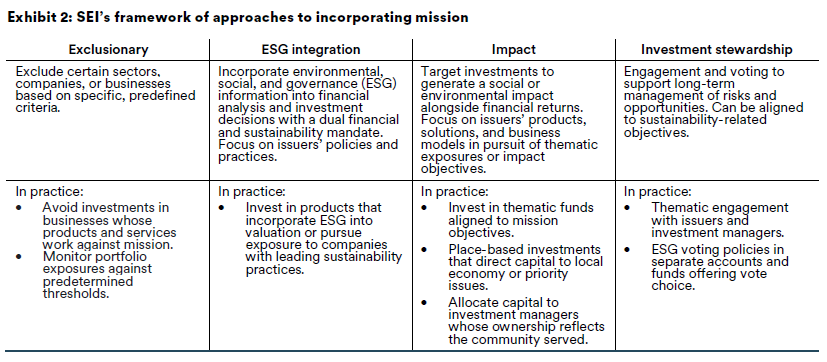
There is no single definition of MAI, nor is there a one-size-fits-all method. Rather, mission alignment in an investment portfolio is best understood as a spectrum of combined strategies calibrated to fit your organization’s specific values and ambitions. SEI’s framework outlines the primary approaches available, along with additional considerations that may be relevant depending on your organization’s mission and community focus.
As your committee drafts the IPS, consider how multiple approaches to mission alignment can reflect the organization’s broader objectives, while creating flexibility across asset classes and investment vehicles that supports the allocation and diversification necessary to help achieve financial objectives.
Beyond financial returns
Beyond the direct investment rationale, there are various organizational reasons for foundations and nonprofits to pursue MAI. The benefits extend beyond the portfolio itself, touching on impact scale, institutional reputation, stakeholder relationships, and the organization’s long-term resilience.
Putting your assets to work
One of the most powerful arguments for MAI is also one of the simplest: The endowment is where the money is. For a typical private foundation, the annual distribution requirement represents approximately 5% of assets, meaning that 95% of the organization’s financial resources remain invested at any given time. We believe if those 95% are invested in companies and industries indifferent or actively opposed to the organization’s mission, the foundation is working against itself with the vast majority of its capital, even as it directs dollars toward change through grantmaking.
MAI offers the opportunity to narrow that gap. Even partial alignment—for example, excluding the most egregious conflicts or directing a meaningful allocation to impact investments—can dramatically increase the share of assets working in harmony with the organization’s goals.
For organizations that have adopted ambitious mission-aligned approaches, the framing has shifted: the endowment is no longer only the financial foundation that supports the work. It is part of the work. The investment portfolio becomes an extension of the organization’s mission expression, amplifying impact well beyond what grantmaking alone can achieve.
Stakeholder engagement
In an era of heightened scrutiny around organizational values and accountability, MAI has emerged as an important dimension of organizational credibility. Donors, grantees, community partners, and the public increasingly expect consistency between what organizations say and what they do.
For organizations that can credibly articulate their approach to MAI, the fundraising and communications benefits may be substantial. Major donors, particularly those focused on impact, are increasingly attentive to how their gifts are managed. The ability to demonstrate that contributions are stewarded in a manner aligned with the organization’s mission can be a meaningful differentiator in donor cultivation and retention. For organizations raising or growing their endowments, the benefits can be even stronger—mission alignment can help donors feel comfortable that their philanthropy has an immediate benefit just as programmatic funding would.
Similarly, for community-focused organizations, the ability to say that your investment portfolio reflects your commitment to the communities you serve, whether through manager diversity, place-based investments, or exclusionary screens that remove harmful industries, can deepen relationships with grantees and partners who are skeptical of the gap between philanthropic rhetoric and financial practice.
MAI also provides compelling material for institutional communications. Annual reports, donor letters, and stewardship conversations can highlight the organization’s holistic approach to impact by demonstrating that the commitment to mission extends across the organization’s resources, not just the money that flows through grantmaking. This is a powerful message for organizations seeking to distinguish themselves in a competitive philanthropic landscape.
Institutional durability
Investment committees face a perennial challenge: leadership changes. Committee members rotate, executive directors and CFOs move on, and the institutional knowledge and clarity that shaped an organization’s investment philosophy can erode over time. Without clear documentation, an approach championed by one generation of leadership may be abandoned quietly by the next.
Embedding MAI principles in the IPS transforms an ambition into enduring policy. When the values, priorities, and parameters of mission alignment are codified in the governing investment document, they become part of the organization’s operations.
New committee members are oriented to the approach from the outset, unfamiliar staff can understand the rationale and history of the organization’s investment philosophy, and the OCIO is accountable to documented standards, not informal preferences.
This durability is not about rigidity. A well-crafted mission-aligned IPS should include provisions for periodic review and updating as the investment landscape evolves, new impact opportunities emerge, and the organization’s priorities mature. The goal is not to freeze the approach but to ensure that changes are thoughtful and deliberate rather than by default or leadership attrition.
The IPS becomes a shared reference point that enables new committee members and executives to build on what came before, rather than starting from scratch. In this sense, a well-constructed mission-aligned IPS is an investment in the organization and its capacity to sustain and advance its mission over the long term.
Getting started
Organizations do not need to have all the answers before beginning this work. The first step is to create space for a focused conversation among the board, investment committee, executive leadership, and OCIO about how the organization’s mission relates to its investment portfolio. Many organizations will delegate leadership of this effort to a staff member who works closely with the board or set up a task force within the board or investment committee. Still others will involve the entire committee in the process. No matter how you structure it, the goal is to foster deliberation and debate that will help the committee to identify its highest-priority issues, clarify any boundaries or trade-offs, determine what success should look like, and begin translating those decisions into clear IPS language.
A mission-aligned IPS does not require an organization to choose between financial discipline and mission integrity. When thoughtfully developed, it can serve as a steady reference point for investment decisions, strengthening governance and helping ensure that the organization’s assets remain oriented toward the North Star that guides its programs, grantmaking, and community impact.
GLOSSARY AND INDEX DEFINITIONS
For financial term and index definitions, please see: https://www.seic.com/ent/imu-communications-financial-glossary
IMPORTANT INFORMATION
This material represents an assessment of the market environment at a specific point in time and is not intended to be a forecast of future events, or a guarantee of future results. This information should not be relied upon by the reader as research or investment advice and is intended for educational purposes only. Diversification may not protect against market risk. There are risks involved with investing, including possible loss of principal.
ESG and Sustainability are not uniformly defined across the industry. Environmental, social and governance (ESG) guidelines may cause a manager to make or avoid certain investment decisions when it may be disadvantageous to do so. This means that these investments may underperform other similar investments that do not consider ESG guidelines when making investment decisions.
Statements that are not factual in nature, including opinions, projections and estimates, assume certain economic conditions and industry developments and constitute only current opinions that are subject to change without notice. Nothing herein is intended to be a forecast of future events, or a guarantee of future results.
Certain economic and market information contained herein has been obtained from published sources prepared by other parties, which in certain cases have not been updated through the date hereof. While such sources are believed to be reliable, neither SEI nor its affiliates assumes any responsibility for the accuracy or completeness of such information and such information has not been independently verified by SEI.
This material is not directed to any persons where (by reason of that person’s nationality, residence or otherwise) the publication or availability of this material is prohibited. Persons in respect of whom such prohibitions apply must not rely on this information in any respect whatsoever.
The views contained herein are not to be taken as advice or a recommendation to buy or sell any investment in any jurisdiction. Our outlook contains forward-looking statements that are judgments based upon our current assumptions, beliefs and expectations. If any of the factors underlying our current assumptions, beliefs or expectations change, our statements as to potential future events or outcomes may be incorrect. We undertake no obligation to update our forward-looking statements.
Information in the U.S. is provided by SEI Investments Management Corporation (SIMC), a wholly owned subsidiary of SEI Investments Company (SEI).
Information in Canada is provided by SEI Investments Canada Company, a wholly owned subsidiary of SEI Investments Company (SEI), and the Manager of the SEI Funds in Canada.
In the UK and the EEA this information issued in the UK by SEI Investments (Europe) Ltd, 1st Floor, Alphabeta, 14-18 Finsbury Square, London EC2A 1BR which is authorised and regulated by the Financial Conduct Authority. Investments in SEI Funds are generally medium- to long-term investments.
This document has not been registered as a prospectus with the Monetary Authority of Singapore.
This information is made available in Latin America, the Middle East and Australia FOR PROFESSIONAL (non-retail) USE ONLY by SIEL.
Any questions you may have in relation to its contents should solely be directed to your Distributor. If you do not know who your Distributor is, then you cannot rely on any part of this document in any respect whatsoever.
SIEL is not licensed under Israel’s Regulation of Investment Advising, Investment Marketing and Portfolio Management Law, 5755-1995 (the “Advice Law”) and does not carry insurance pursuant to the Advice Law. No action has been or will be taken in Israel that would permit a public offering or distribution of the SEI Funds mentioned in this email to the public in Israel. This email and any of the SEI Funds mentioned herein have not been approved by the Israeli Securities Authority (the “ISA”).
The Shares may not be offered, sold or delivered directly or indirectly in the US or to or for the account or benefit of any US Person except pursuant to an exemption from, or in a transaction not subject to, the registration requirements of the Securities Act of 1933 and any applicable state laws.
Any questions you may have in relation to its contents should solely be directed to your Distributor. If you do not know who your Distributor is, then you cannot rely on any part of this document in any respect whatsoever.