Quarterly Economic Outlook: Canada: Resources, resilience, and reinvention.
“We cannot change the cards we are dealt, just how we play the hand.”—Randy Pausch, The Last Lecture
The breakdown of Canada-U.S. trade talks in August marked a low point in the third quarter of 2026, and investors could be forgiven for thinking things just keep getting worse. While these are challenging times, unbridled pessimism is misplaced in our view.
First, the Canadian economy and financial markets have continued to demonstrate resilience. Second, the effective U.S. tariff rate, though higher since August, is still among the lowest globally, and the latest round of tariffs and countermeasures will hurt businesses and consumers on both sides of the border, not just those to the north. Finally, despite being dealt a tough hand on the trade front, Canada has some valuable cards to play in the current global environment. Hard times are creating opportunities to pursue a more productive and diversified national economy. While much of the work still lies ahead, the Carney government is pulling a diverse range of levers in its attempts to do so.
Resources: Favourably positioned in a resource-hungry world
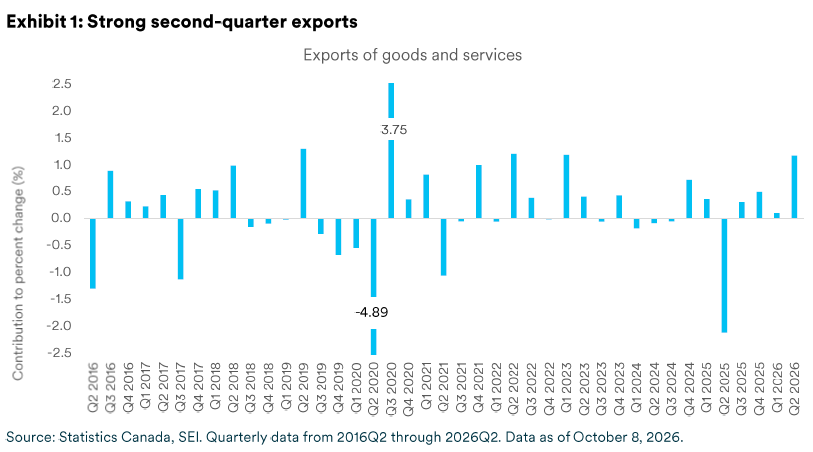
With plentiful resource endowments and a reputation as a reliable trade partner, Canada is one of the better-positioned economies in a world where numerous countries are trying to build less-fragile supply chains and more secure reserves of key commodities. In our prior Economic Outlook, we argued that the outlook for exports looked encouraging, and subsequent data have affirmed our view. As shown in Exhibit 1, exports of goods and services picked up considerably in the second quarter. And according to StatCan’s monthly trade data, August showed the net trade balance increasing by nearly a factor of four versus July despite a stronger Canadian dollar. Granted, much of the August impulse was almost certainly due to front-running of the latest Canada-U.S. tariffs. But the trend in exports should remain solid, especially given global demands for energy products.
Resilient: Businesses and consumers
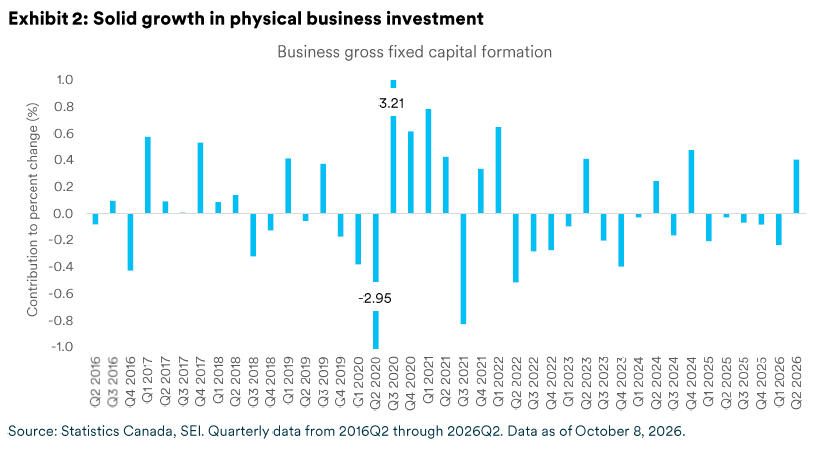
Business fixed investment also experienced a strong rebound in the second quarter, as shown in Exhibit 2. It is worth nothing that intellectual property growth was down slightly in the same period, so intangible business investment still has plenty of room for improvement. In the meantime, exports of energy products, consumer goods, machinery, and electrical equipment are helping support the domestic economy, and a strong global-growth environment should foster further investment by Canadian businesses.
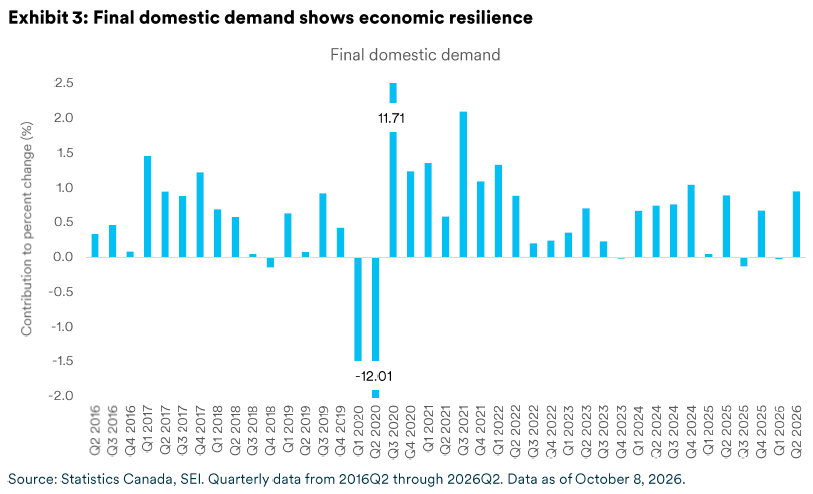
Although it has displayed quarter-to-quarter volatility in recent years, final domestic demand also contributed meaningfully to second-quarter activity as shown in Exhibit 3. Household consumption expenditures have been a notably supportive component in 2026.
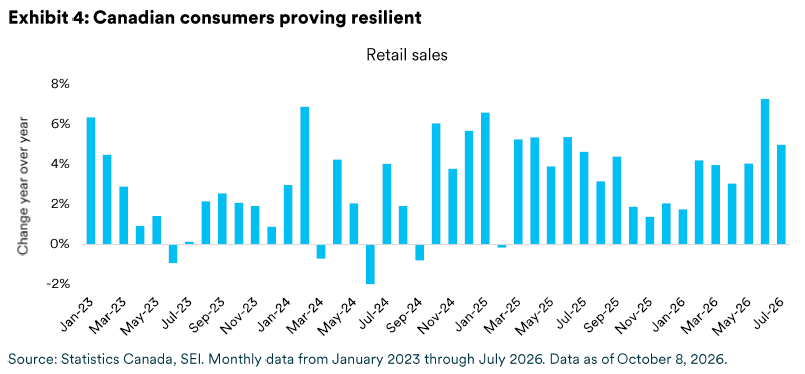
Encouragingly, higher-frequency measures of retail activity indicate that this consumer strength is likely to continue. As shown in Exhibit 4, Statistics Canada’s Monthly Retail Trade Sales data continued to strengthen this year through July. More recently, RBC’s Consumer Spending Tracker for August showed month-on-month acceleration. While higher energy prices are certainly part of the consumer-spending story, the pace and categories of discretionary purchases indicate that Canadian consumers remain resilient.
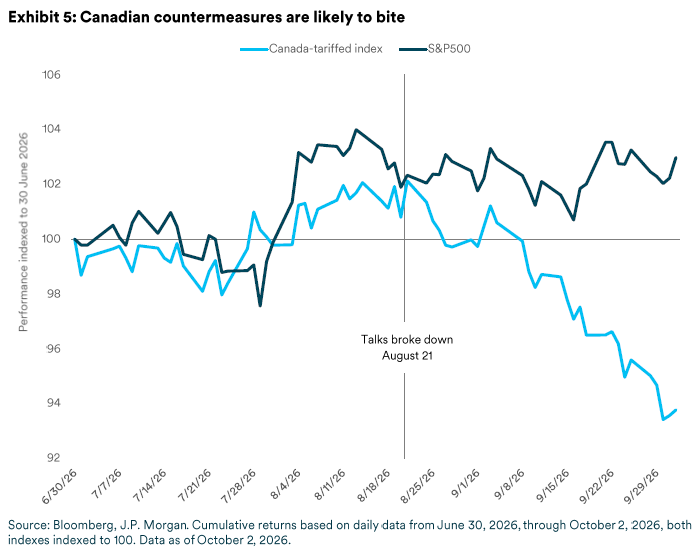
Of course, we can’t dismiss the latest round of U.S. tariffs (including a small number of total exclusions announced in late September) or Canadian countermeasures out of hand. The so-called Section 338 tariffs and the Carney government’s dollar-equivalent retaliation are effectively tax hikes on businesses and consumers, with the ultimate effects dependent upon the behavioral responses of both groups. Jobs will be lost, economic activity will be marginally slower, and some prices will rise. While we’ve previously argued that imposing tariffs is often akin to shooting both you and your trade partner in the foot, the Carney government’s response seems to have ample political support for now. And while both parties tend to lose in a trade war, Canada’s countermeasures are likely to cause some pain south of the border. As shown in Exhibit 5, a basket of publicly traded U.S. companies exposed to Canadian tariffs has underperformed the broader U.S. stock market considerably since trade talks broke down in late August.
The composition of goods tariffed under U.S. Section 338 is also worth thinking about. For some of the affected goods, some amount of trade will likely revert to domestic instead of cross-border consumers. And given the work that’s been put into diversifying and expanding Canada’s trade relationships beyond the U.S., other goods may find buyers elsewhere; that’s especially true for goods with a high ratio of value to shipping costs, as it makes rerouting worthwhile. For businesses and workers producing goods that don’t meet those criteria—goods with a much smaller domestic market or low value and expensive to ship—there is almost certainly some unwelcome pain ahead.
The Canada-U.S. trade asymmetries are undeniable, and the net impact on the U.S. of the latest tariffs will pale in comparison to the effects on Canada’s economy. However, Canada still enjoys one of the lowest overall effective U.S. tariff rates, and Canadians can hope that negatively affected American businesses and consumers communicate their pain clearly to elected officials, including the Trump Administration.
Resilient: Financial markets
Resilience has also been apparent in Canadian financial market performance. In the 2020s, Canadian equities, as measured by the S&P/TSX Composite Index (TSX), have outperformed the U.S. benchmark S&P 500 Index by a significant margin. According to TD Economics, the only decade where relative performance was better occurred in the first decade of this century.
Canada’s government bond yields are currently among the lowest in the G7, and its latest inflation readings are in the middle of the pack and relatively well behaved. While lower bond yields make sense given the country’s relatively slow growth and moderate inflation, they indicate that markets don’t expect the Bank of Canada to face the same pressures to hike policy rates as some of its central bank peers. At the margin, this should be supportive of the physical investment cycle that’s underway in Canada and hopefully just getting started.
Relatively tame bond yields also provide an opportunity to remind investors that, among advanced economies, the Canadian government has ample fiscal space for managing through a highly uncertain period. If this firepower can be used wisely, some degree of economic reinvention should be attainable.
Reinvention: Is it possible?
In a word, yes, and it’s something economists have talked about for years. But we do have to be honest about the prospects for economic reinvention. The concepts of “factor endowments” (Canada’s natural resource wealth) and “path dependence” (the current state of productive affairs) have a significant influence on the scope of future possibilities. But there are reasons for hope. While the Canadian economy is unlikely to undergo a total transformation, there are meaningful opportunities to create a wealthier and more productive society. The Carney government has done an admirable job of identifying and starting to pull on some of the levers that could make that happen.
Expanded trade relationships are probably the most obvious area. Granted, it’s hard to substitute for a large, wealthy, net-importing neighbour with whom you share a 5,000-mile-long border and, in some key industries, tightly integrated supply chains. But as the opening quote of this Outlook says, you have to play the hand you’re dealt. Increasing trade volumes with non-U.S. partners are a sign that progress is being made on this front. The harder lift might be at home, where a loosening of constraints on interprovincial trade is a key ingredient of reinvention. The Canadian Federation of Independent Business (CFIB)’s recent report on interprovincial cooperation offered reasons for optimism but also warned that many small businesses were not yet seeing concrete results from the agreements, commitments, and legislation that have occurred to date. It’s worth noting that differing provincial priorities have essentially shut down the opportunity to bring Europe (which is in dire need of new energy suppliers) on board as a key customer. Some Canadian liquified natural gas (LNG) will make its way to Europe, but not in the quantities or as directly as some had hoped, and Asian LNG customers will remain paramount.
Fostering a friendlier environment to business investment is another key initiative, and there are reasons for optimism on this front. Federal efforts to streamline approvals, support infrastructure projects, and allow immediate expensing of capital investments suggest policymakers are serious about tackling some of the barriers that have weighed on investment and productivity growth. The potential upside from these measures, especially in a best-case scenario, is probably hard for many to fully grasp. It’s still early days, but there’s a real chance that we see a sustained upturn in business investment in the coming years and into the next decade. Done well, the payoffs should be ample.
Human capital might be the area that’s most underappreciated, but the Carney government is clearly focused on it. According to the OECD, Canada has one of the best education systems, and one of the best-educated populations, in the world. However, homegrown talent has long been drawn abroad, especially to the U.S. As the Conference Board of Canada recently pointed out, for decades, outward migration of Canadian immigrants has occurred most frequently among those with higher degrees. In essence, Canada does a wonderful job investing in and developing human talent, but it has some trouble retaining it. This challenge isn’t unique to Canada, but when it comes to economic reinvention, it’s a critical area to focus on. The current U.S. administration seems committed to alienating researchers and turning away talented immigrants, creating opportunities the Carney government is attempting to seize upon. Significant federal funding aimed at attracting global talent to Canada was announced in late 2025, and it has shown signs of success in 2026, including a number of U.S. researchers relocating to the north. As a recent Forbes article put it, Canada’s brain drain may be shifting into a brain train. If this can be sustained, the potential benefits shouldn’t be underestimated!
As uncertain as the future looks (and it always does), there’s plenty of clarity around the hand that the Canadian economy and policymakers have been dealt. It’s a long, tough game, but all things considered, it’s not a bad hand; and so far, it’s being played skillfully.
The investment upshots
As hopeful as we are for the Canadian economy in the years ahead, we’re also realists. The global and domestic economic environments are very different from the ones that prevailed for most of this century. Demands on financial capital are intensifying around the world, and the makeup of capital providers has shifted in ways that mean interest rates are likely to stay higher for longer. Demands on many real resources have intensified at a time when global supplies seem more uncertain than ever. The unfolding AI-investment boom—along with ongoing military conflicts and geostrategic rivalries—come with far more questions than answers.
As always, there will be winners and losers, but the dynamics influencing those outcomes have shifted meaningfully in recent years. For investors, the focus should remain on personal objectives, capacity to take risk, and diversification. Sound allocation advice and active management may prove valuable in a rapidly changing global environment.
GLOSSARY AND INDEX DEFINITIONS
For financial term and index definitions, please see: https://www.seic.com/ent/imu-communications-financial-glossary
IMPORTANT INFORMATION
SEI Investments Canada Company, a wholly owned subsidiary of SEI Investments Company, is the Manager of the SEI Funds in Canada.
The information contained herein is for general and educational information purposes only and is not intended to constitute legal, tax, accounting, securities, research or investment advice regarding the Funds or any security in particular, nor an opinion regarding the appropriateness of any investment. This information should not be construed as a recommendation to purchase or sell a security, derivative or futures contract. You should not act or rely on the information contained herein without obtaining specific legal, tax, accounting and investment advice from an investment professional. This material represents an assessment of the market environment at a specific point in time and is not intended to be a forecast of future events, or a guarantee of future results. There is no assurance as of the date of this material that the securities mentioned remain in or out of the SEI Funds.
This material may contain "forward-looking information" ("FLI") as such term is defined under applicable Canadian securities laws. FLI is disclosure regarding possible events, conditions or results of operations that is based on assumptions about future economic conditions and courses of action. FLI is subject to a variety of risks, uncertainties and other factors that could cause actual results to differ materially from expectations as expressed or implied in this material. FLI reflects current expectations with respect to current events and is not a guarantee of future performance. Any FLI that may be included or incorporated by reference in this material is presented solely for the purpose of conveying current anticipated expectations and may not be appropriate for any other purposes.
Information contained herein that is based on external sources or other sources is believed to be reliable, but is not guaranteed by SEI Investments Canada Company, and the information may be incomplete or may change without notice. Sources may include Bloomberg, FactSet, Morningstar, Bank of Canada, Federal Reserve, Statistics Canada and BlackRock.
There are risks involved with investing, including loss of principal. Diversification may not protect against market risk. There may be other holdings which are not discussed that may have additional specific risks. In addition to the normal risks associated with investing, international investments may involve risk of capital loss from unfavourable fluctuation in currency values, from differences in generally accepted accounting principles or from economic or political instability in other nations. Emerging markets involve heightened risks related to the same factors, in addition to those associated with their relatively small size and lesser liquidity. Bonds and bond funds will decrease in value as interest rates rise.
Index returns are for illustrative purposes only, and do not represent actual performance of an SEI Fund. Index returns do not reflect any management fees, transaction costs or expenses. Indexes are unmanaged and one cannot invest directly in an index. Past performance does not guarantee future results.
Commissions, trailing commissions, management fees and expenses all may be associated with mutual fund investments. Please read the prospectus before investing. Mutual funds are not guaranteed, their values change frequently and past performance may not be repeated.