Capital expenditure-induced selloff? We were not surprised.
Corporate investment in artificial intelligence (AI) has reached unprecedented levels, with expected spending by major technology companies increasing nearly eightfold since 2020. As the leading technology companies began reporting weaker free cash flows—a consequence of this investment—investors grew increasingly skeptical about whether the scale of AI spending will generate adequate shareholder returns. We argue that such skepticism is not only justified, but also predictable—and therefore avoidable.
What history tells us
History shows that some of the greatest technological revolutions created enormous economic value while destroying shareholder wealth: Canal Mania of the 1700s, the Railway Boom of the 1800s, Automobile Revolution of the 1900s, and the Dot-Com Boom of the 2000s. When industries invest aggressively at the same time, future competition, excess capacity and lower returns on capital follow.
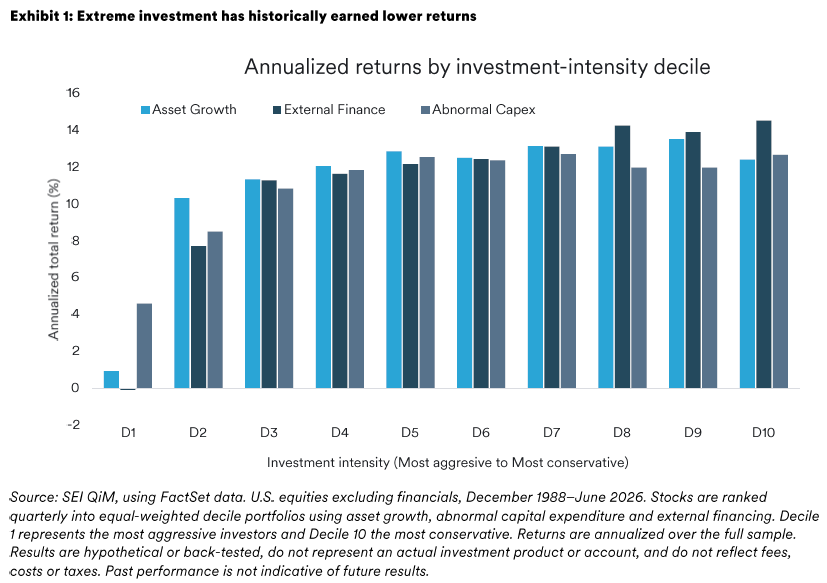
Does history still apply? Academic research has long documented that the firms investing most aggressively tend to deliver weaker subsequent stock returns. Inspired by Titman et al (2004), Bradshaw et al. (2006), and Cooper et al. (2008), we examine three indicators of over-investment: asset growth, abnormal capital expenditure, and external finance. Consistent with their findings, we observe that overinvestment has been associated with weaker subsequent stock returns.
The asymmetry is also noteworthy. Returns do not continue improving monotonically as companies invest less. Avoiding investment altogether is not the answer either.
Is this time different?
AI may indeed prove different. Demand may continue growing for many years, and today’s investment may eventually be justified by future earnings.
But there are several ways that relationship could disappoint. Improvements in AI model and hardware efficiency could reduce the computing capacity required for a given level of AI output. Monetization could develop more slowly than investment, particularly if customers prove unwilling to pay enough for AI services to support the infrastructure behind them.
There is also a competitive dimension. Amazon, Microsoft, Alphabet, and Meta are not investing in isolation. Each may have a rational reason to expand capacity, but simultaneous expansion can produce excess capacity at the industry level even when the individual investment decisions initially appear reasonable.
What do we watch?
Periods of rapid technological change often increase the gap between winners and losers, creating a richer opportunity set for disciplined stock selection. The question is not whether AI succeeds, but whether it succeeds by more than investors already expect.
No single metric can determine whether today's AI investments will generate attractive shareholder returns. Our research therefore combines information from company fundamentals, valuation, capital allocation decisions, market expectations and investor behavior. By integrating multiple independent signals, we seek to distinguish between companies generating durable improvements in profitability and those benefiting primarily from optimistic expectations.
GLOSSARY AND INDEX DEFINITIONS
For financial term and index definitions, please see: https://www.seic.com/ent/imu-communications-financial-glossary
IMPORTANT INFORMATION
This material represents an assessment of the market environment at a specific point in time and is not intended to be a forecast of future events or a guarantee of future results. All information as of the date indicated. There are risks involved with investing, including possible loss of principal. This information should not be relied upon by the reader as research or investment advice, unless you have otherwise separately entered into a written agreement with SEI for the provision of investment advice nor should it be construed as a recommendation to purchase or sell a security. The reader should consult with their financial professional for more information.
Statements that are not factual in nature, including opinions, projections and estimates, assume certain economic conditions and industry developments and constitute only current opinions that are subject to change without notice. Nothing herein is intended to be a forecast of future events, or a guarantee of future results.
Certain economic and market information contained herein has been obtained from published sources prepared by other parties, which in certain cases have not been updated through the date hereof. While such sources are believed to be reliable, neither SEI nor its affiliates assumes any responsibility for the accuracy or completeness of such information and such information has not been independently verified by SEI.
This material is not directed to any persons where (by reason of that person's nationality, residence or otherwise) the publication or availability of this material is prohibited. Persons in respect of whom such prohibitions apply must not rely on this information in any respect whatsoever.
The information contained herein is for general and educational information purposes only and is not intended to constitute legal, tax, accounting, securities, research or investment advice regarding the strategies or any security in particular, nor an opinion regarding the appropriateness of any investment. This information should not be construed as a recommendation to purchase or sell a security, derivative or futures contract.
You should not act or rely on the information contained herein without obtaining specific legal, tax, accounting and investment advice from an investment professional.
The views contained herein are not to be taken as advice or a recommendation to buy or sell any investment in any jurisdiction. Our outlook contains forward-looking statements that are judgments based upon our current assumptions, beliefs, and expectations. If any of the factors underlying our current assumptions, beliefs or expectations change, our statements as to potential future events or outcomes may be incorrect. We undertake no obligation to update our forward-looking statements.
Information in the U.S. is provided by SEI Investments Management Corporation (SIMC), a wholly owned subsidiary of SEI Investments Company (SEI).
Information in Canada is provided by SEI Investments Canada Company, a wholly owned subsidiary of SEI Investments Company (SEI), and the Manager of the SEI Funds in Canada.
In the UK and the EEA this information issued in the UK by SEI Investments (Europe) Ltd, 1st Floor, Alphabeta, 14-18 Finsbury Square, London EC2A 1BR which is authorised and regulated by the Financial Conduct Authority. Investments in SEI Funds are generally medium- to long-term investments.
The contents of this document have not been reviewed by any regulatory authority in Hong Kong. You are advised to exercise caution in relation to the offer. If you are in any doubt about any of the contents of this document, you should obtain independent professional advice.
This document has not been registered as a prospectus with the Monetary Authority of Singapore.
This information is made available in Latin America, the Middle East and Australia FOR PROFESSIONAL (non-retail) USE ONLY by SIEL.
Any questions you may have in relation to its contents should solely be directed to your Distributor. If you do not know who your Distributor is, then you cannot rely on any part of this document in any respect whatsoever.
Issued in South Africa by SEI Investments (South Africa) (Pty) Limited FSP No. 13186 which is a financial services provider authorised and regulated by the Financial Sector Conduct Authority (FSCA). Registered office: 3 Melrose Boulevard, 1st Floor, Melrose Arch 2196, Johannesburg, South Africa.